Swipe Our Budget-Friendly Local SEO Strategy to Dominate Maps
September 22, 2026 by Robert Portillo
Quick Answer: Dominating Maps, Old Spots and New. A budget-friendly local SEO strategy means optimizing your Google Business Profile, technical SEO foundation, and local content instead of paying directories or ads for visibility you don't own. Most of it costs time, not money. One real example: a client went from page 4 to page 1 of Google in 15 months, with a 73% jump in site visits, running this exact system. It also works for new service areas, ranking places you don't currently show up, without opening a new physical location.
The Problem: You're Renting Visibility You'll Never Own
You're probably paying to be invisible, and it's about to get worse.
Most small business owners don't realize how much of their visibility is rented instead of owned. If your business depends on directories like Yelp, Angi, Thumbtack, or Nextdoor to get found, you're renting visibility you don't own. Stop paying, and you disappear. Now Google's AI Overviews are doing the same thing at a bigger scale: pulling answers from those directories instead of crawling your own site, so you're paying for the platform that gets the credit while your business gets a footnote.
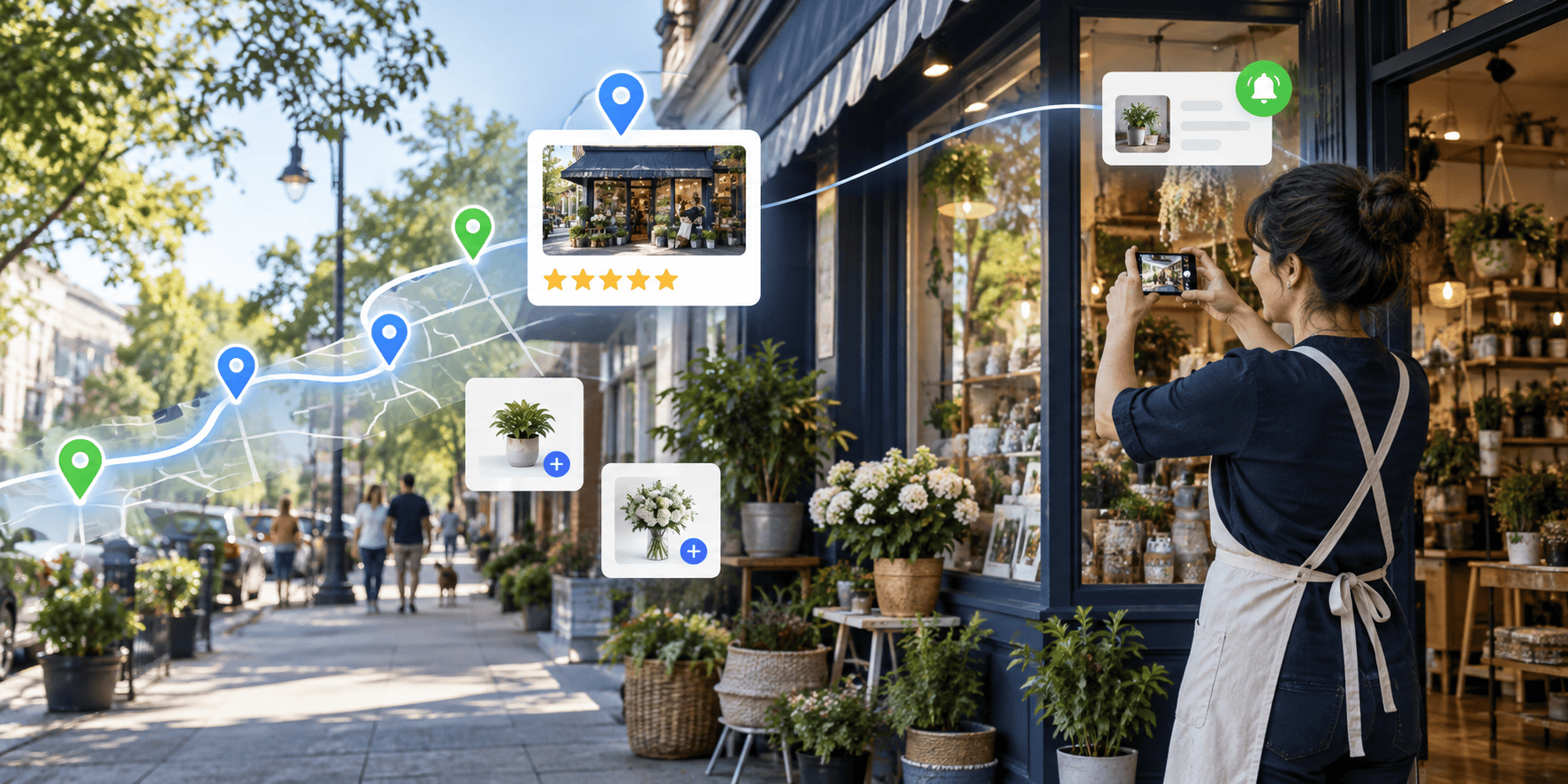
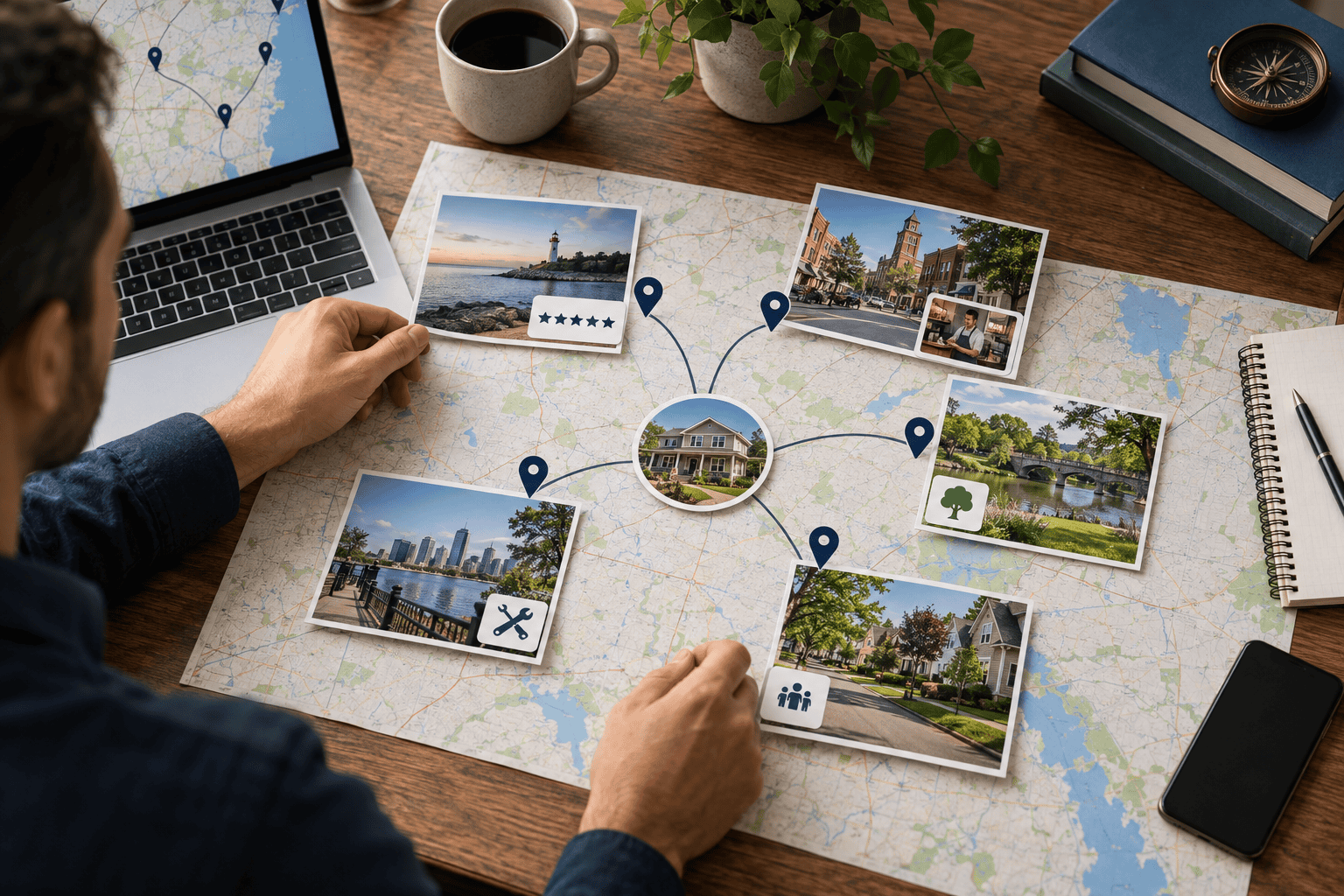
A budget-friendly local SEO strategy fixes both problems at once: it rebuilds your local and online visibility around assets you actually own. That means ranking better in the spots where you already show up, and it means showing up in Map Pack results for the neighborhoods and service areas you don't currently rank in, all without opening a single new location. Here's the exact system, the part you can run yourself, and the order to do it in.
What This System Actually Did
Before the how, here's the proof it works.
One client we worked with went from page four of Google to page one in 15 months. Daily site visits grew 73%. People searching for the business by name went from almost nothing to over 30,000 searches in under a year. And visibility in "near me" search results (the kind that drives calls and walk-ins) went from 27% to 98%.
No new location, no rebrand, no big ad budget. Just the system below, run consistently: the same fixes that let a single-location or service-area business start showing up in new map locations, which is exactly what Fix #3 walks through.
Free SEO for 30 Days
See what this exact system can do for your business before you spend a dollar. We'll run it on your site free for 30 days. No contract, no card required.
✓ Full technical + Google Business Profile audit
✓ Real fixes applied to your site, not just a report
This is the one almost every small business SEO effort skips, and it's invisible until someone shows you. It's also usually the first thing a technical SEO audit turns up, the kind agencies charge for. The good news is you can run the same checks yourself before organic traffic ever starts moving.
A handful of on-page SEO basics do most of the heavy lifting, and none of them cost anything but time:
Optimizing titles and meta descriptions on every page, written for the actual service-plus-area combination ("Roof Repair in Riverside, CA" beats "Our Services").
Internal linking between your service pages and any new location pages you build, so both Google and visitors can find them.
A quarterly technical audit: Google Search Console (free) will surface broken links, duplicate title tags, and slow pages before these small technical fixes quietly bleed rankings. This is the core of technical optimization, and it's the part most "affordable SEO packages" skip entirely.
Basic keyword research before you write, not after. A free tool or even Google's autocomplete shows how real customers phrase what they need, which should shape your headings, not just your copy.
Schema markup gets oversold constantly. Plenty of people selling "advanced schema" promise ranking gains it doesn't actually deliver, so treat those pitches skeptically. The one type genuinely worth prioritizing is review schema: it's what puts star ratings directly in your Google search result, which lifts click-through rate even without changing your position. Basic Organization and Local Business schema are worth setting up once (quick for a developer, no downside), but treat them as standard baseline setup, not a ranking strategy.
Special case, menu, catalog, or booking widgets: If your business runs on an embedded menu, product catalog, or booking system (restaurants, delivery services, appointment-based businesses), test it yourself in 2 minutes: right-click the page → "View Page Source" → search for one of your actual service terms. If you can't find it in the raw code, Google can't either, no matter how good the page looks in a browser. This happens constantly with widgets and JavaScript-heavy catalogs that render fine for a human and blank for a search engine. If yours fails, ask your platform provider for the "indexable" or "crawlable" version. Most have one, they just don't surface it by default.
Fix #2: Dominate the Map Pack
This is where most local searches actually get decided, and Google Business Profile optimization is almost entirely free to work on.
Get your primary Google Business Profile category right. A vague or wrong category is the single most common reason a business doesn't show up. Pick the most specific accurate category, then stack relevant secondary categories on top.
Upload real photos weekly, not stock images. Actual photos of your storefront, team, and work signal an active, real business.
List your products or services with prices directly on your profile. Most businesses don't know this feature exists, and it shows up in Maps ahead of anything a directory offers.
Post updates regularly: a promotion, a new arrival, a seasonal note. Costs nothing but a few minutes.
Treat reviews as reputation management, not a box to check. Aim for 10+ new reviews a month and respond to every single one. Response rate factors into ranking, not just star average.
Fix #3: Build Local Landing Pages to Conquer New Map Locations
This is the part that actually gets you into new map locations, not just a stronger position in the one you already show up in. This isn't about content strategy in the abstract, it's about proving, area by area, that you belong in the local pack, which is what actually moves your rankings.
Google won't rank you in a new city because you say you serve it. It wants proof, at three levels:
A dedicated page for each new area, not one page listing ten towns. This means real content creation for each area, not swapping the city name into a template. One page per service area with locally specific language (streets, response times, local landmarks) beats a shared page every time.
A defined service area in your Google Business Profile. If you have a physical location, add the neighboring cities and zip codes you genuinely serve, but note that Google still anchors your rankings to your real address, so this helps for nearby areas, not far-off ones. Reaching a distant market usually requires an actual local presence.
Local signals that back up the claim: reviews that mention the area by name, local citations in that area's directories, and content referencing local events or landmarks.
A few phrasing patterns that work well across almost any local business:
"Serving [Neighborhood] since [Year]" "Located next to [Local Landmark]" "We service [list specific streets/areas]" "[Number] five-star reviews from [City] customers"
One more thing worth getting right: Google has an actual, named policy against the shortcut version of this. Doorway pages, pages "targeted at specific regions or cities that funnel users to one page," or that are substantially similar copies with only the city name swapped, are explicitly called out as spam. Get caught doing that at scale, and Google doesn't just ignore the pages; it can suppress the whole site.
The fix takes more effort than a find-and-replace template, but it isn't complicated: each area page needs something real and specific to that area, meaning the streets you actually cover, response times, a landmark or neighborhood detail that only makes sense there, and reviews naming that city. That's the local data that makes the page legitimate.
The opposite failure mode is just as common, though. Stuffing the page with generic facts about the city (its founding year, population, "top attractions") that have nothing to do with your business turns it into a thin Wikipedia knockoff instead of a business page, and it doesn't fool Google any more than the templated version does. Every fact on the page should answer one question: does this help someone deciding whether to hire you in this specific area? If not, cut it.
Fix #4: Make Your Content Citable by AI (GEO)
GEO (Generative Engine Optimization) is the practice of structuring content so AI systems like Google's AI Overviews, ChatGPT, and Perplexity can find, understand, and cite your business directly, instead of defaulting to a directory. It's the same groundwork as Fixes #1 through #3, aimed at a slightly different reader: the model summarizing an answer, not just the person searching.
Answer questions directly, in the first sentence of a section. AI systems lift the sentence that answers the query cleanly, not the best-written paragraph three lines down.
Lean on the review and basic business schema from Fix #1. It's a reasonably clear signal for a machine reading your page, on top of whatever click-through benefit it already earns in search. Don't expect it to do more than that.
Write so each section stands on its own. Avoid vague references like "these" or "our approach" without saying what, specifically, since AI systems often pull a single passage out of context and it needs to still make sense.
Keep your name, address, phone number, and service details identical everywhere: your site, your Google Business Profile, every directory listing. AI systems cross-reference multiple sources before deciding what to cite, and inconsistency is the fastest way to get skipped.
None of this replaces Fixes #1 through #3. It's built directly on top of them.
Earn Local Citations and Backlinks Without an Ad Budget
Link building has a reputation for being expensive. At the local level, it usually isn't.
Local business directories and chamber of commerce listings are free or low-cost, and double as local citations, helping both rankings and the "is this a real business" trust signal.
Sponsor a local event, team, or fundraiser. Most will link back to your site: high quality backlinks that are genuinely earned instead of bought.
Write a guest post for a local news site or community blog in any new area you're targeting. It reinforces that you actually operate there, which strengthens the location pages above.
The Budget-Friendly Math
Compare this to what you're likely already spending. Every dollar into directory listings, Google Ads, or Meta Ads stops earning the moment you stop paying: that's rented visibility. Every dollar into your own site's content, structure, and citations keeps bringing in potential customers long after you've stopped spending on it. None of this is a one-time fix. It's a system for sustainable growth, week over week, the difference between Google rankings you rent and business growth you actually own. That's the real case for calling it "budget-friendly" instead of just "local SEO."
Your 30-Day Plan
Week 1: Technical foundation. Run the page-source test, fix title tags and meta descriptions, set up schema markup, and format key answers for direct extraction (GEO) if needed.
Week 2: Google Business Profile. Correct your category, add products/services with pricing, upload this week's photos, respond to every open review.
Week 3: New locations. Pick 1-3 new areas to target, build your first local landing pages, update your GBP service area.
Week 4: Citations and measurement. Start local citation and backlink outreach, then check Search Console against where you started. Look hard at what you're paying directories for, and start cutting what isn't earning its keep.
When to Bring in Professional Help
None of this requires an agency to start. But if you're a growing or medium-sized business already juggling daily operations, tight budgets, and multiple locations, small business SEO services can get you there faster than DIY, provided they offer tailored strategies for your actual target audience, not a one-size-fits-all package, and ongoing support instead of a one-time audit and disappearing act.
That distinction matters: search "affordable SEO company" and you'll get a lot of noise. Plenty of SEO companies for small businesses sell a $99/month package that does nothing and market it as professional services. What you actually want from digital marketing help is simple: someone applying this exact system to your specific market, not a template with your city name swapped in.
Do You Actually Have Time for This?
Running the full system above takes roughly 20–30 hours to set up, plus 2–4 hours a week ongoing (photos, reviews, posts). Drag the slider. These are rough estimates grounded in the 30-day plan above, not padded to make a point.
Hours per week you can realistically give this: 5
FAQ
There's no fixed price, and the cost of affordable SEO services varies a lot by provider. Most of what moves the needle above is free: it costs time, not money. The real fixed costs are usually schema markup setup and, if you want faster results, SEO consulting. Compare that to ongoing directory or ad spend, which never stops paying.
Yes. Local SEO optimizes for a specific geographic area and leans on signals like your Google Business Profile and nearby citations. National SEO targets broad, non-geographic search terms across the whole country. A business with one or two locations rarely needs a national strategy: it needs to own its local ground first.
Not necessarily, especially at the start. Everything in the Fix sections above is doable without one. Where a consultant or agency earns their fee is technical audits, schema markup, and speed, if you don't have the time to run this yourself.
This falls under GEO (Generative Engine Optimization), covered in Fix #4. AI Overviews pull answers from whatever sources Google trusts most for a given query, increasingly well-structured content on your own website and complete Google Business Profiles, not just directories. The fixes here (structured content, a complete profile, real location pages) are exactly what makes a business eligible to be cited instead of skipped.
Expect early movement in Google Business Profile visibility within weeks, and 3-6 months for new location pages to gain real traction, longer in competitive industries like law firms or other dense, high-competition local markets.
Want Us to Run the Numbers on Your Business?
We're a marketing agency focused on affordable, hands-on local SEO, not a factory checklist. Try the exact system from this article on your own business before committing to anything.
Free SEO for 30 Days
A full audit plus 30 days of real optimization work on your site and Google Business Profile. No contract, no obligation.
BroBex Marketing is a local SEO agency built on one principle: SEO should earn its place, not be sold on promises. We don't take every client. We take only the ones we're confident we can help, and we prove it first — 30 days free, daily updates, no long-term contract required.
This exact system above? It's not theory. It's what we've run for hundreds of small-to-mid-sized local businesses over the past decade.
Robert Portillo — Founder & Local SEO Specialist
Robert Portillo runs BroBex and has spent the last 15+ years working on SEO and digital visibility for some of the most recognized brands in the country — from Hollywood studios to Fortune 500 companies to local service businesses that needed to own their search results.
His background includes:
15+ years of hands-on SEO work — starting with organic search optimization for major studios, moving to local SEO and business growth for regional and national brands
Direct experience with the exact problem this article solves — watching businesses waste money on directory listings, AI Overviews, and rented visibility instead of building their own
Proven track record with local ranking improvement — the case study in this article (page 4 to page 1 in 15 months, 73% traffic growth) is real, and it's one of dozens of similar results from clients using this same system
How We Verify This Works
The case study isn't luck or cherry-picked. It came from:
Consistent methodology: The same four fixes applied, in order, across hundreds of clients
Measurable results: Tracked in Google Search Console, Google Business Profile, and real business outcomes (calls, walk-ins, online conversions)
Competitive markets: These results came from clients in high-competition local spaces (service areas with dozens of competitors doing the same work)
Third-party verification: Results validated against each client's own analytics, not just our metrics
What Sets This Apart
A lot of people sell "budget-friendly SEO." Here's what makes BroBex different:
We say no to 75% of potential clients. That's not marketing; that's our actual acceptance rate. We only work with businesses we're confident we can help with this exact system. If we don't see a clear path to improvement, we tell you that upfront instead of signing you for 12 months.
30 days free isn't a trial; it's proof. Most agencies offer free consultations and vanish. We offer 30 days of actual SEO work — daily updates, real optimization, measurable progress — before you pay a dime.
We don't hide the work. The "Daily Velocity System" means you see exactly what we did, why we did it, and how it helped. No black box reports three months later saying "rankings improved."
Transparency
Don't take our word for it. Here's what you can check yourself:
Run a Google Business Profile audit. Check their category accuracy, photo recency, review response rate, and service area definition. Those are the exact signals in Fix #2 above.
Use Google Search Console (free) on your own site to verify technical issues exist and matter. You'll see the exact same broken links, duplicate title tags, and crawl errors we mention.
Compare your own site to competitors using a free tool like Ubersuggest or SEMrush's free tier. Look at their backlink profile, their internal linking structure, and how they handle local pages. This isn't magic — it's structural patterns you can see and copy.
This system works because it's based on how Google actually ranks local businesses, not on promises or proprietary tech.
Robert Portillo is a seasoned digital marketing and CRO expert, leading BroBex Marketing and CRO Junkies. With a focus on SEO, conversion optimization, and strategic growth, he helps businesses maximize their online success.